A Masked Ball
Giuseppe Verdi 1813–1901
Melodramma in 3 acts.
Libretto by Antonio Somma after Eugène Scribe
World premiere February 17 1859, Teatro Apollo, Rome.
Sung in Italian with German & English surtitles
Introductory talks begin in the Holzfoyer 30 minutes before curtain up, and appear here, and everywhere podcasts can be found, shortly after opening night
Conductor Thomas Guggeis / Simone Di Felice
Riccardo Matteo Lippi
Amelia Guanqun Yu
Renato Mikołaj Trąbka
Ulrica Emanuela Pascu
Oscar Anna Nekhames / Younji Yi°
Silvano Taehan Kim
Samuel Pete Thanapat
Tom Inho Jeong
A Judge Michael McCown
°Member of the Opera Studio
Dancing on a razor’s edge: Riccardo has an affair with his best friend’s wife. The result? Deadly!
After Giuseppe Verdi laid his foundation stones for future success with operas like Rigoletto, La Traviata and Il trovatore in the 1850s, he started looking for new challenges, feeling drawn to works which combined humour with tragedy, instead of the »monotony« of Italian melodramme, and discovered Eugène Scribe’s play Gustave III ou La bal masqué, based on the murder of the King of Sweden in 1792. He set it to music, with his librettist Antonio Somma, but it quickly fell foul of Italian censors: killing a monarch on stage was just not on, which led to the setting for the opera being changed several times.
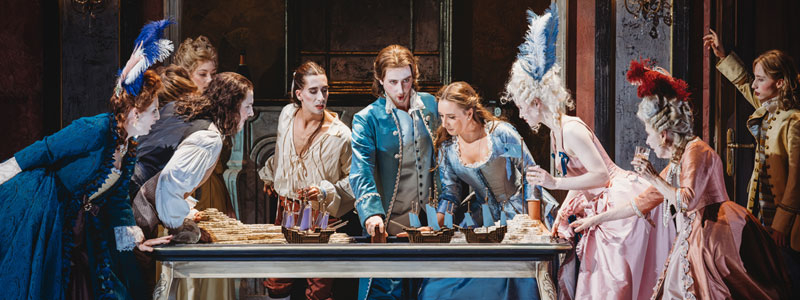
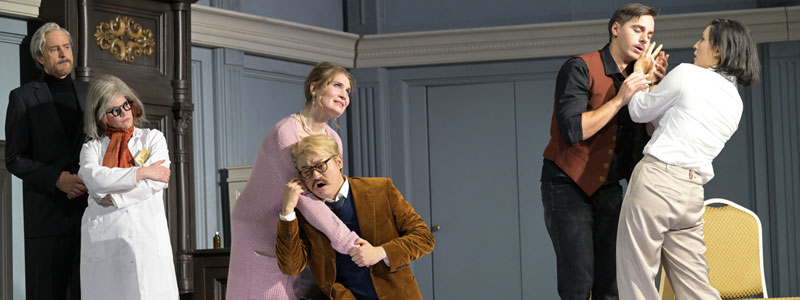
At the world premiere in Rome 1859 the action took place Boston. Verdi was more interested in the »dramatic situations« his protagonists found themselves in, which he brought to life with oodles of psychological sensitivity, than historical context: Riccardo’s having an affair with Amelia, wife of Renato, his friend and advisor. He brushes aside the fact that his assassination’s being planned, choosing to enjoy the more pleasurable things in life. Renato interrupts a rendezvous between Riccardo and Amelia. Wounded to the core, he joins the conspirators and shoots Riccardo dead at a masked ball.
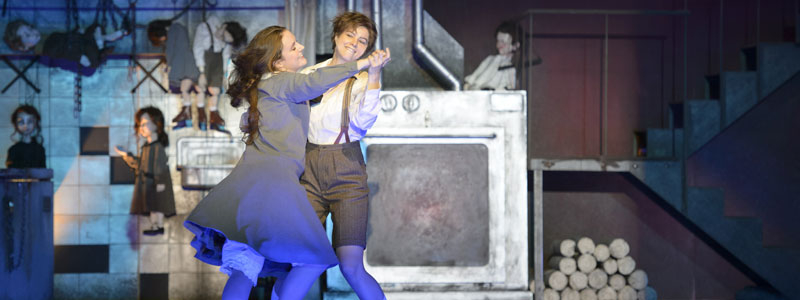
The contrasts in the libretto are mirrored in Verdi’s score: The love scenes between Amelia and Riccardo have an intimate, almost transcendental quality, while dangerous ones often turn grotesque. The music drives the characters sometimes dancing, sometimes whispering to the sticky end the seer Ulrica prophesied earlier on in the opera.
Thanks to ROECKL for their partnership.
With generous support from