Aida
Giuseppe Verdi 1813–1901
Opera lirica in 4 acts
Libretto by Antonio Ghislanzoni after Auguste Mariette
World premiere December 24 1871, Opera House, Cairo
This production first seen December 3 2023
Sung in Italian with German & English surtitles
an introductory talk starts in the Holzfoyer 30 mins before performances begin, is available here and everywhere where podcasts can be found.
Conductor Pier Giorgio Morandi
Aida Nombulelo Yende
Radamès Young Woo Kim
Amneris Sofija Petrović
Ramfis Andreas Bauer Kanabas / Kihwan Sim
Amonasro Iain MacNeil
King of Egypt Thomas Faulkner
A Messenger Kudaibergen Abildin
A Priestess Alina Avagyan°
°Member of the Opera Studio
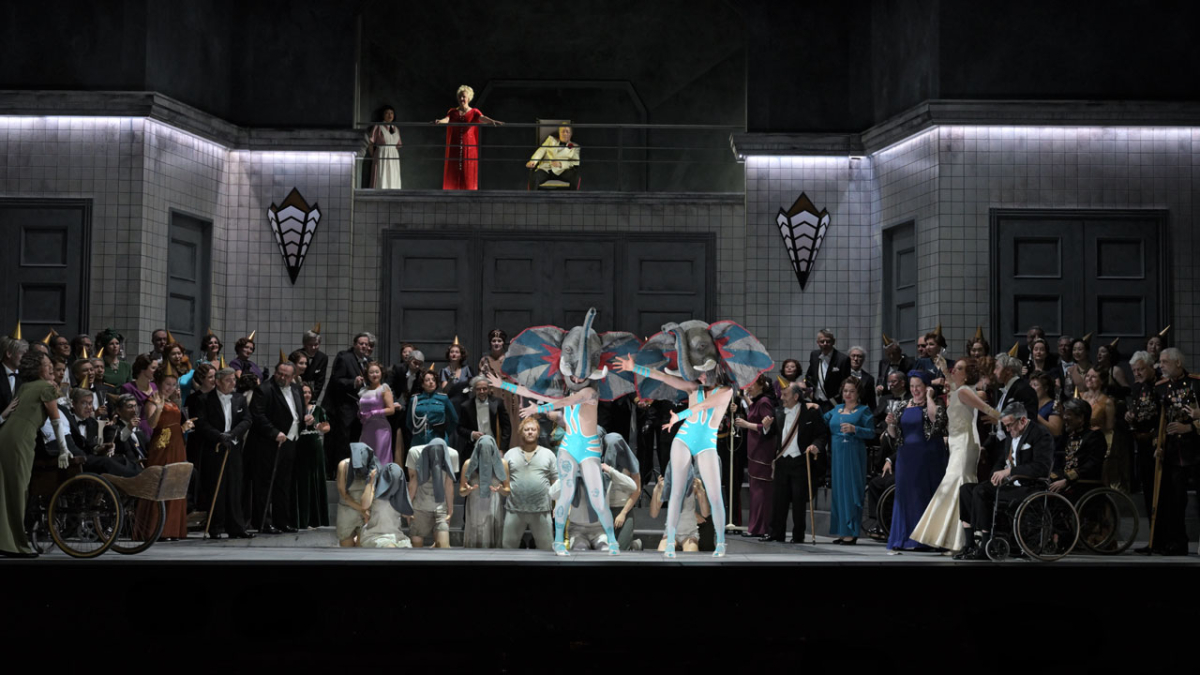
Egypt’s at war with Ethiopia. The precarious Egyptian regime could crumble so the elite have barricaded themselves into a luxuriously equipped bunker, trying to forget their fear of doom by forcing Ethiopian slaves to play perfidious games. One of the prisoners is the Ethiopian King’s daughter: Aida. It hasn’t escaped Princess Amneris’ notice that Aida and the young Egyptian Radamès are in love. She had her eye on Radamès too, so their relationship’s a thorn in her side. Suddenly, at the High Priest Ramfis’ behest, Radamès is chosen to lead the Egyptians against the Ethiopians. Divine providence has, supposedly, ordained it so. Almost simultaneously Ramfis is haunted by terrible pangs of guilt: How many young men have already died in this war? Act II The Egyptian army returns victorious with more prisoners, including Aida’s father, the Ethiopian King Amonasro. Radamès is to be given Amneris’ hand in marriage to reward his military success. INTERVAL Amonasro coerces Aida into gleaning secret military information from Radamès, which she does, but in Amonasro’s hearing. Amneris finds them: Radamès is arrested for treason; Aida and Amonasro manage to escape. Act IV Amneris regrets her intrigues and attempts, in vain, to save Radamès from death. But, seeing no point in living without Aida, he surrenders to his punishment without a fight: He’s to be walled up alive. Aida follows him to the world hereafter.
The Ethiopian princess, Aida, is the Egyptian King’s daughter, Amneris’, slave. Both are in love with a young Egyptian, Radamès, who loves Aida. He’s been chosen to lead the army against the Ethiopians, his beloved’s own people. How do people react in wartime? Where does freedom begin? What does homeland mean? Verdi’s Aida shows how people try and follow their own gut feelings while faced with inhumane conditions, to have feelings and relationships; but also about how they can be instrumentalised and finally crushed by uncaring power hierarchies. Lydia Steier sets the story inside a bunker, during a brutal war. Oppressively relevant, her drastic reading combines associations with present-day war zones and memories of the end of World War II, turning this popular work, written in 1870/71, when France was at war with Germany, for the new opera house in Cairo, into bitterly-cynical echoes of warring euphoria, which runs like a red thread through the history of mankind.